
Private Spiritual Work with Sheikh Ibn Malik Alhabhab
Speak directly with Sheikh Ibn Malik Alhabhab on WhatsApp about private spiritual work. Discuss your request, the cost and any delivery details before you decide to order.
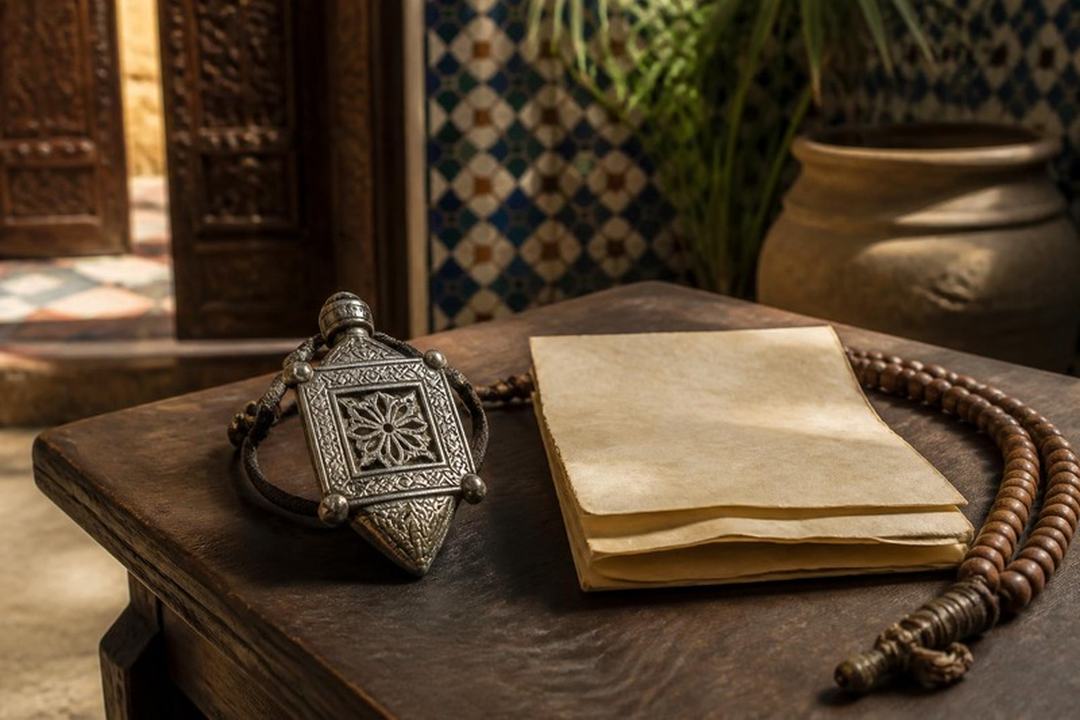
Moroccan talisman traditions are not one single system. The objects people call amulets or talismans reflect varied histories, materials, faiths, local craft and family memory. A motif may mean different things to different wearers, so the most respectful starting point is to ask who made an object, where its design comes from and what its owner associates with it.
In everyday use, “talisman” can describe an object kept for personal, cultural or spiritual significance. “Amulet” is often used for an object associated with protection. These labels overlap, and neither gives a reliable explanation of a specific Moroccan piece by itself. The wearer’s own account, the maker’s information and the object’s documented context matter more than a broad label.
Moroccan adornment includes work from many communities and regions, with silver, other metals, beads, stones, enamel and leather among the materials found across different forms. Geometric forms, handwork and inscriptions can all appear, but a shape alone is not enough to identify its origin or meaning. Museum records, such as the Metropolitan Museum of Art’s collection entries for Moroccan Amazigh ornaments and fibulae, show why an object’s material, date and provenance should be considered together.
See a Moroccan Amazigh ornament in the Met collection and a pair of fibulae. These records are useful examples, not a complete account of Moroccan practice. Similar-looking motifs can travel, change and acquire different meanings over time.
Start with the seller’s exact description and separate what is observable from what is interpreted. A photograph can show a shape or finish; it cannot by itself establish a date, maker, regional origin or spiritual effect. For an older or high-value object, ask for provenance records and consider an independent specialist. For a new piece, clear material details and honest limits on what is known are useful signs of a transparent listing.
Ask whether the description refers to the maker’s own explanation, a documented source or the seller’s interpretation. Request confirmation of metal content, stone type, dimensions and any known repairs. If the seller cannot verify an origin or date, a clear answer such as “unknown” is more useful than a confident but unsupported story. Keep screenshots of the listing and written answers with your order records.
No. Meaning depends on the object, its history and the person or community describing it. A product label should not be taken as proof of a universal belief.
No. Motifs can be shared or reinterpreted, and age or origin needs evidence such as reliable provenance, maker information or specialist assessment. Ask the seller what is known and what is uncertain.
Ask about materials, dimensions, craftsmanship, care, stock, delivery and returns. If you are considering a Khodamdjin piece, contact Sheikh Ibn Malik Alhabhab on WhatsApp for product-specific details before ordering. Cultural and spiritual interpretations are personal; no particular outcome is promised.